
Highlights from Washington
by Erin Lease, Kutztown University
An Interview with Mary Beth Monroe, AAPT Melba Newell Phillips Medal recipient
 |
|
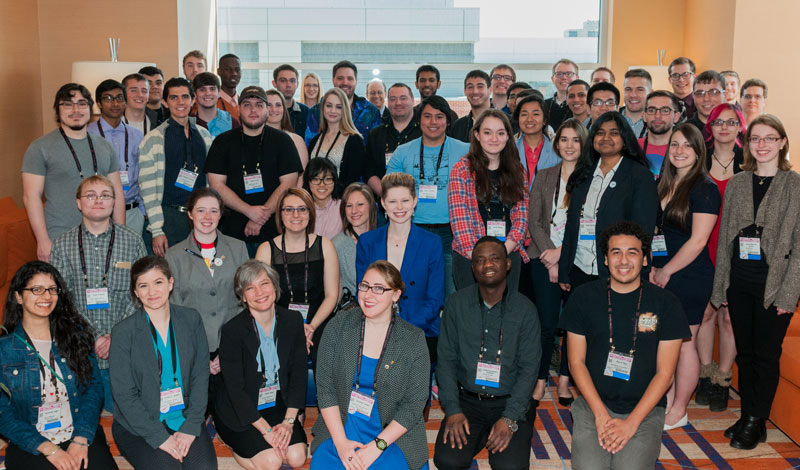
SPS members Laura Johnson and Lauren Kendall enjoy the student reception following an APS careers panel.
Photo by Luke Heselden |
|
AAPT/APS Poster Session and Student Meet-and-Greet
The poster session and reception was a great change to meet with students from all over the United States and the world. Meeting and talking to so many students from all around gave me many new ideas about the kinds of physics I could study and the research positions that are available at different universities. I had the opportunity to speak with a graduate student who is working at CERN in Switzerland. There was a very intriguing poster on sensing ground motion with triangular lasers. I also spoke with a student who works in an area of physics I had never even heard of. He utilizes 2-dimentional analysis, stereo imaging, and airglow tomography for measurements of upper atmospheric phenomena. The atmospheric phenomena include lightning induced transients called "sprites" and "elves." I was completely intrigued when this student said his research was on sprites and elves. I have never heard a physicist talk about elves in a serious fashion.
Session: Re-Energizing America's Focus in STEM Education
The first speaker in this panel was Linda Slakey, Acting Executive Officer of the Education and Human Resources Directorate for the National Science Foundation. Slakey talk about good practices in teaching, like not lecturing for fifty minutes, using lab time effectively, and getting feedback from students. I found Slakey’s presentation very engaging and being a resent high school graduate, I know from experience teachers need to vary day-to-day activities in order to engage students.
There are many challenges facing physics education, such as high school teachers without degrees in physics. Also, within college classrooms the teaching practice doesn’t always align with what we know about how to promote learning. Thanks to Slackey, I learned that there are many ways to address the gap between what students are learning and current physics research. For example, by promoting evidence-based learning and teaching and bringing current research into the classroom.
The next speaker was Shirley Malcolm from the American Association for the Advancement of Science (AAAS). The main question in her talk was, “Who is going to do physics and engineering when students aren’t interested?”
There are many ways of looking at the natural world and for that we need new faces and ideas in science. Those of us already working or studying in the sciences need to show students that they are missing a great element in their lives. Students need to be motivated with hands on activities and lessons that relate to the students lives, such as cars or cell phones. Students should also be engaged in research activities and activities where they believe they can do well. Malcom spoke of the fact that if students are competing and believe they won’t do well, they won’t.
Malcom also talked about how the STEM community does not look like the population, another reason why students from all types of cultures and backgrounds should be recruited.. AAAS believes it is important to invest in our students and to dedicate grants to finding and executing new ways to educate students and teachers. She also talked about changing the high school agenda and making sure that science is valued.
AAPT Award Ceremony
At the award ceremony, four different awards were presented to teachers and professionals from different areas in physics. Mary Beth Monroe was awarded the Melba Newell Phillips award; her speech was very touching. The Melba Newell Phillips Medal is AAPT's highest recognition of member leadership and service. When Monroe was finished speaking, I found myself wanting to speak with her about how she has gotten to where she is today and her dedication to her students. She called being awarded the Melba award a great honor, and said that her work is really in collaboration with the other two year college teachers and AAPT.
The J.D. Jackson Excellence in Graduate Education Award was awarded to Eugene Cummings for his work at the University of California. Cummings gave a presentation about the graduate students he has worked with over the last 40 years. He spoke with great pride when he discussed his students and how over the years he has kept in touch with them. He is proud of his students and enjoys working with his past graduate students. Cummings talked about how bright and imaginative his students are. He spoke of his life as a grad student and how on telling his dad that he was working on time reversal, his father replied, “hurry up I’m 64!” Cummings was a delightful person to meet and listen to; he is a very kind teacher who truly enjoys his work and his students.
After Dr. Cummings speech, three AAPT Distinguished Service Citations were awarded to Karen Williams, Patrick Whippey and Trina Cannon. Williams is a professor at East Central University in Oklahoma and an active officer within AAPT, holding every office possible over the years. She is also involved with NSF grants for training teachers in the physical sciences.
Patrick Whippey was awarded next for his contributions to the Ontario section and the Executive Board. Whippey does science presentations for middle school and high school students and works with the Science Olympiad competitions. When I learned that he works with the Science Olympiad I was very excited-I participated in the olympiad as a student. Whippey was a very nice man and I talked with him about what I am currently working on and my plans for the future.
Lastly, Beverly T. Cannon was presented with her award. Cannon is a high school teacher who enjoys sharing physics with all who will listen. She holds high school teacher workshops and has dedicated her time to serving AAPT. Her students call her Mrs. Physics, and appreciate that she always brings cool stuff to class from AAPT meetings.
Session: How to advocate for science locally, regionally, and nationally
One of the many talks on advocating for science was by the WGBH station in Boston, which produces one of the greatest science shows on TV today, NOVA. The speakers informed the audience that students around age 18 spend 20% of their time in classrooms. But, over the course of a lifetime, people will actually be engaged in schooling less than 10% of the time. This shows that we need to get science out to the public. One of their efforts has been on connecting NOVA to Science Cafes.
The greatest idea I've ever heard that brings science to people that wouldn’t normally discuss science is Science Cafes. Science Cafes enable unscripted conversations between a scientist and the public. A science café usually meets in a casual meeting place, and is organized around an interesting topic of conversation. A scientist gives a brief presentation and sometimes shows a short video clip to kick off an informal discussion. This gives the public a chance to discuss science in a way that they normally wouldn’t. This kind of actively engages all sorts of people not in school or actively engaged in science.
Science Cafes have an amazing effect on participants, with 83% reporting that they continue to discuss the topics with family and 81% recommending the cafes to their family. What is even more amazing is that post café surveys found that 71% of the participants continued to follow the topics they learned about at the cafes by reading articles online. In addition, the scientist speakers found that after presenting they had a new outlook on how they think about science.
Session: Physics and Society education
There were many interesting speakers during the session on physics and society. The first was on sustainable energy. John Roeder presented information from David MacKay’s book Sustainable Energy without the Hot Air. This presentation was very eye opening. The talk discussed the amount of green houses gases in the atmosphere, and little things that people can do in their homes and lives that can help the environment.
The next speaker was Charles Ferguson, a physicist who works in government policy. Ferguson was an interesting speaker with a nontraditional career path. He is now working on countering nuclear and radiological terrorism and education policy. Ferguson spoke of the need to know about and understand weapons of mass disruption, not destruction. He talked about the use of explosives, panic, and food irradiation, and why the government needs scientific and technical expertise.
The final talk was by Gordon J. Aubrecht, titled “Can Science help counter suspicion of the consequences of Climate Change?” Aubrecht talked about the importance of providing hands on science experience for people, so they can understand the process of scientific investigation. Scientist use principles that are tentative, because the knowledge we have is always progressing. As teachers and students within science we need to learn to communicate clearly the facts about science and how things work.
At the end of the session I felt well informed on the issues surrounding sustainable energy, and I felt motivated to tell more people about science and really explain it to them. All the speakers were passionate about their topics and helping the environment and the community. |