
From the Rose Bowl to Gamma-Ray Bursts: The AAS 213th Meeting
by Therese Jones, Penn State SPS President, State College, PA
 |
|
| Ryan Letcavage, Penn State University SPS member. |
|
Having left a bit early for this year’s meeting to watch Penn State in the Rose Bowl, I managed to make it to Long Beach in time to attend several of the pre-meeting workshops. Both workshops I attended were International Year of Astronomy focused, and were free to attend. The first, focused on Hands-On Optics and the Galileoscope, involved a plethora of demonstrations using lenses, lasers, UV beads, and a black light. We each received a free kit containing these items and mini-telescopes, which our chapter has already used at an elementary school science day and while teaching middle school Science Olympiad students.
The second workshop I attended was on Dark Sky Awareness; a primary goal of the International Year of Astronomy is focused on the reduction of light pollution across the globe. We used light-meters to determine the amount of extraneous light emitted from different light fixtures. Campaigns in several cities have aimed to switch fixtures so that they point downward, dramatically decreasing the light pollution. After our real demonstration, we were given a tour through the IYA dark skies Second Life Island, where you (as Galileo) are capable of traveling around a city and exploring the light pollution that exists. Other topics that were covered the workshop included environmental impacts of poor lighting, designated Dark Sky sites across the U.S., and Astronomy photography. The November 2008 National Geographic issue has great coverage of this topic, for anyone who wants to learn more.
After the Dark Skies workshop, the conference kicked off with the undergraduate reception and opening reception. Over the past three years, I have perceived these receptions as social events to reunite with colleagues/classmates, and make connections, but this year, as I was applying to graduate school, the events served as time to run around and find representatives from each graduate school I was interested in attending. Graduate schools generally send at least one representative to talk to prospective students, so it is important to complete applications prior to the meeting; that way they can find you during your poster session.
The following four days were packed with plenary talks, oral sessions, and poster sessions. I spent every day, but Wednesday, my poster day, running from session to session, trying to catch as many extragalactic astronomy and cosmology talks as possible. One of the plenary sessions this year, given by Roger Blandford, was on the Decadal Survey; every ten years the Astronomical community must report on the state of the field, as well as future plans and projects. Numerous white papers have been released as part of this survey, covering all areas of astronomy from research to diversity in astronomy, and provide a good overview of recent research as well as the state of the profession.
 |
|
Rebecca Green, Penn State University Astronomy major. |
|
I had intended to visit a few of the oral sessions on my poster day, but my Chambliss Award judges were scheduled to visit during the talks I wanted to attend. Given to undergraduate and graduate students (separate categories for each), the Chambliss award is presented to several students each meeting for the best poster presentation. Two judges visit each poster, and rank it based upon its layout and the student’s explanation of their own research. Having presented at numerous conferences in the past, including the International Conference of Physics Students in Cracow this past year, explaining the details of my research to the judges was simple.
I presented research on strong Mg II absorbers along quasar and Gamma-Ray Burst sightlines. Quasars and GRBs, as they are extremely luminous, may be used to study material between us and the quasar/GRB, as seen by absorption lines in the object’s spectrum. At present, it seems that there are four times as many of these absorbers toward GRBs than toward quasars; one would not expect a difference in numbers if the absorbers were all due to random galaxies along the line of sight. I performed an analysis of the absorption profiles of the absorbers in the two different categories in an attempt to determine if the difference in numbers was due to material in the GRB host galaxy, but found that it was impossible to distinguish between the quasar and GRB absorption profiles, suggesting that the excess is not due to GRB host galaxy gas. The cause of this difference is still unknown, although some light may be shed on the issue via imaging of the GRB fields.
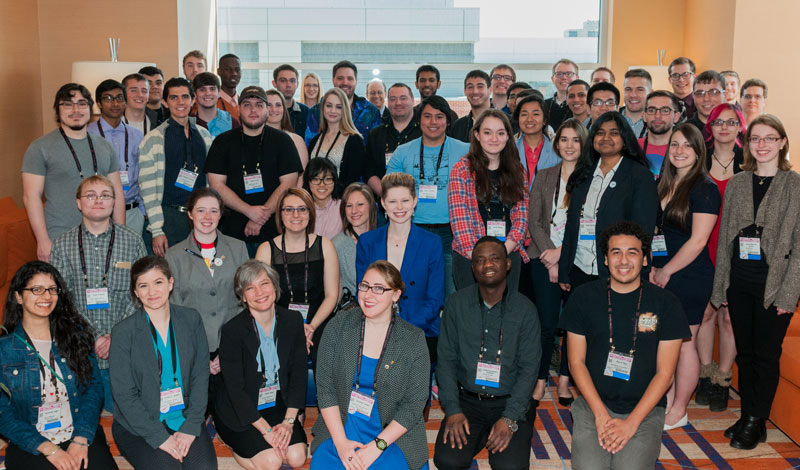
Four other undergraduates from my university presented as well (several are pictured above), and I met numerous other undergraduates who had done the same REU program I participated in several years ago, or worked with advisors who I had met previously. I met up with Rachael Roettenbacher, another student who attended the 2008 International Conference of Physics Students (ICPS), in Crawcow, Poland, who was presenting the research she worked on at Lehigh University. The people who I encounter at the meeting never cease to amaze me; the final meeting highlight was seeing Neil degrasse Tyson break out his dancing moves on the last night of the meeting.
With so many ground-breaking ideas, new technologies, and innovative workshops, AAS meetings provide a new perspective into the field of astronomy annually. Outside regular meeting sessions, collaborations occur constantly, as many of the most brilliant minds on the planet converge at one location. The meeting experience, although perhaps first intimidating for undergraduates, provides valuable insight into the inner-workings of the field. |